


22 de October de 2015
Authors: Lucas Ferreira Furlan and Sérgio Mastellini ABSTRACT: This article calls for a clear and concise analysis of current Brazilian parliamentary political landscape, with the main objective to demonstrate its main problems and point out possible paths to for your solution. Briefly we will discuss the fragmentation of political currents […]
31 de August de 2015
Author: Joana de Menezes Araújo da Cruz Abstract: This dissertation demonstrates that the right to civil disobedience, a modality of law to the popular resistance, consists in a fundamental right extracted implicitly from the Constitution of 1988. Nevertheless, society and State have a complex relationship with the protesting disobedience. However, […]
24 de July de 2015
Author: Aldenir Brandão da Rocha Abstract: This study discusses the role of government relations advisors within the Brazilian National Congress, in a context of unregulated activity. The study assumes that, despite the absence of specific rules governing lobbying, these professionals perform tasks typical of the activity. For an initial approach […]
1 de July de 2015
Author: Ciro Oliveira Abstract: This article deals about the Federation of Industries of the Espírito Santo State (Findes), your creation, relation of interest and relationship with capixaba government. However, the focus is to deal with Findes in the Government of Christiano Dias Lopes (1967-1971), who was the first bionic governor […]
30 de April de 2015
Author: Telma Luciana Hoyler Abstract: Is there an institutionalized pattern of public-private relationship regarding policies of land use, which explains the victories achieved by the real estate industry? To provide an answer to this question, this work investigates the interest intermediation between state bureaucracies and real estate developers when it […]
29 de April de 2015
Author: Claudio Milano Abstract: This dissertation highlights the promotion of tourism in the Parnaíba River Delta, and more specifically in Ilha Grande de Santa Isabel, Piauí state, Brazil. The research explores the transformations experienced by the island community related to the emergence of old and new tourism practices (federal tourism […]
29 de April de 2015
This dissertation highlights the promotion of tourism in the Parnaíba River Delta, and more specifically in Ilha Grande de Santa Isabel, Piauí state, Brazil. The research explores the transformations experienced by the island community related to the emergence of old and new tourism practices (federal tourism promotion, real estate/investment and […]
11 de March de 2015
Author: Francisco Sérgio Oto Souza Bonelli Abstract: This dissertation is dedicated to the lobby analysis, focused on its practice (lobbying) and its regulation in Brazil. Therefore, at first, its origins are studied, followed by a comprehensive analysis of the lobby term and concepts taken from the areas of Political Science […]
16 de January de 2015
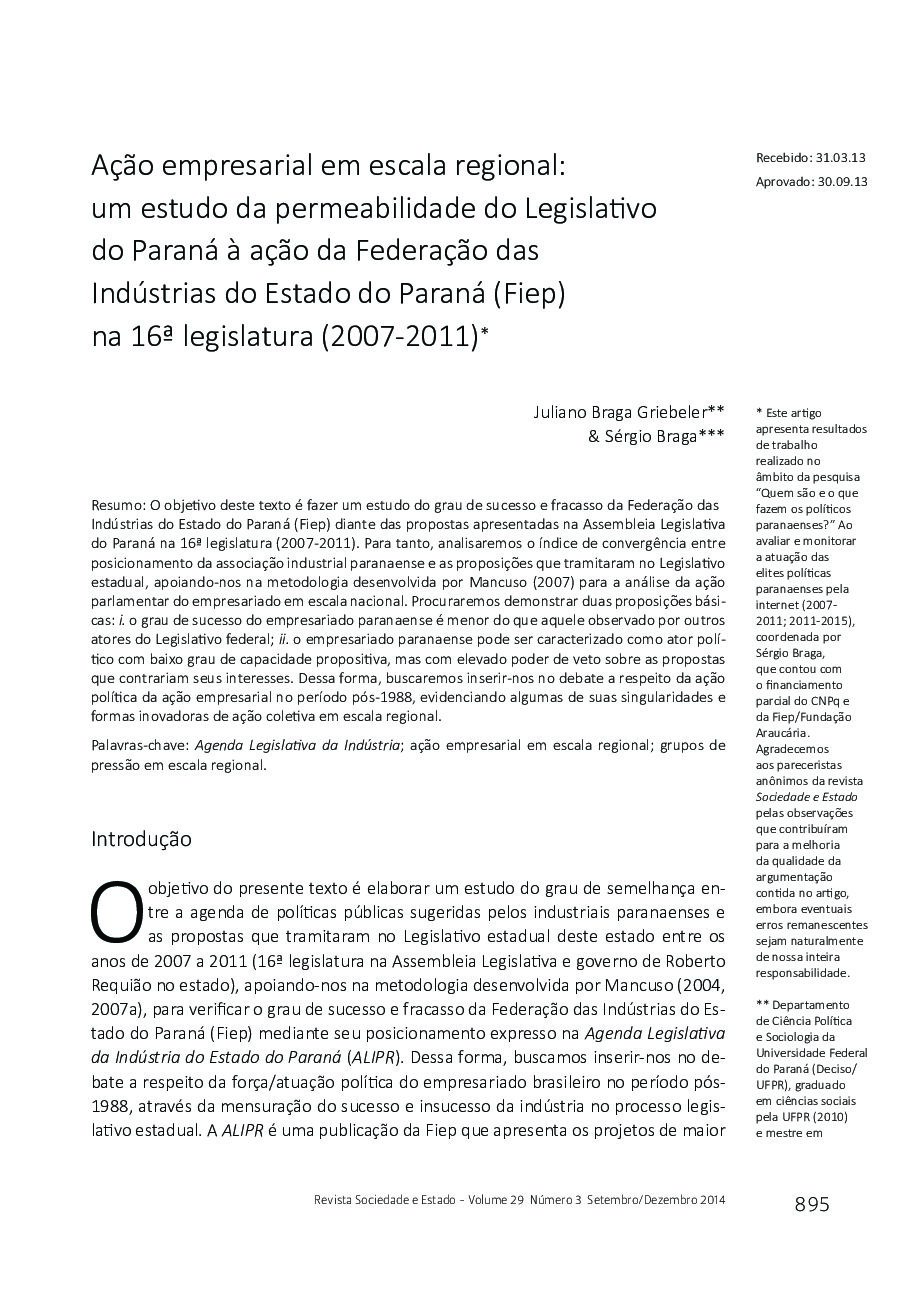
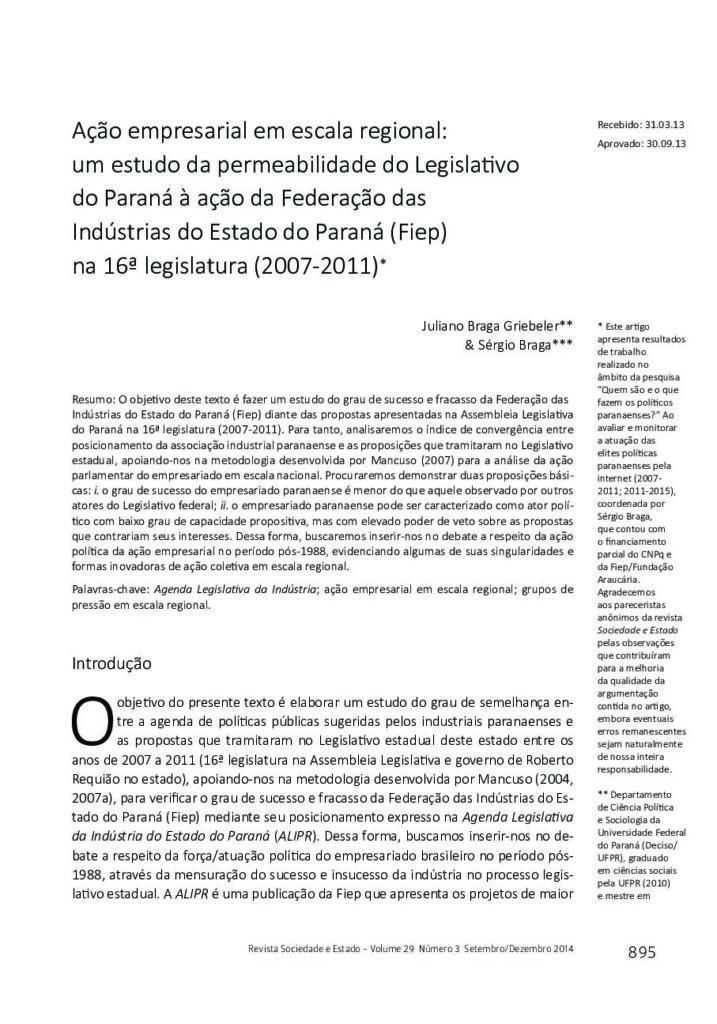
Authors: Juliano Braga Griebeler and Sérgio Braga Abstract: The purpose of this paper is to study the degree of success and failure of Federation of Parana State Industry (Fiep) on the proposals submitted at the 16th Legislature (2007-2011) of the Legislative Assembly of Parana. To materialize this purpose, we analyze […]
1 de January de 2015
Author: Diego Silveira Coelho Ferreira Abstract: This text, essayistic, conducts, through a survey bibliographical study, a study of the use and definition of the concept of power in the literature political science, with an emphasis on research on the political action of the business community in Brazil. In the first […]
1 de January de 2015
Author: Patricia Espinoza Revollo Abstract: This thesis investigates the emergence of an indigenous middle class between 1975 and 2010 in Bolivia – a country characterized by poor and unstable long-term economic growth, high inequality, and enduring ethnic and class cleavages. The study takes a twotiered approach. It focuses first on […]
1 de January de 2015
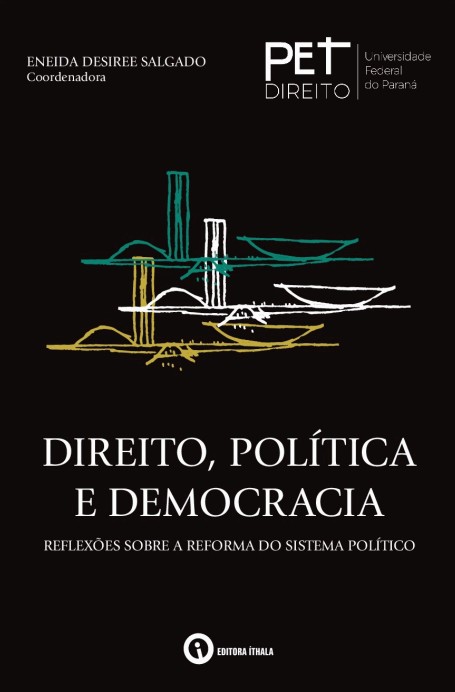
Book DIREITO, POLÍTICA E DEMOCRACIA: Reflexões sobre a reforma do sistema político (Editor: Eneida Desiree Salgado) Authors: Claudio Roberto Barbosa Filho and Vitor André Brandão Müller Abstract: Identifying the practice of lobbying groups in the country’s legislative bodies is necessary to delineate the idea of lobbying and demystify, academically and […]
1 de January de 2015
Authors: Flávia Cristina Silveira Lemos, Dolores Galindo, Daiane Gasparetto da Silva, Marcelo Moraes Moreira and Bruno Jay Mercês de Lima ABSTRACT: This article examines the practices of resistance to gags in democratic contexts. The institutional crisis of global and Brazilian democracies was accompanied by movements that have not ceased to […]
1 de January de 2015
Author: HELOISA DE CARVALHO FEITOSA VALADARES Abstract: This dissertation aims to analyze the alleged crisis of representativeness experienced in Brazil and discussed by theorists simultaneously. The representation, figure from the scope of private law, is maximum example paradoxes of democracy, originally intended as a Government of the people. Their integration […]
1 de January de 2015
Author: Lucas Nascimento Ferraz Costa Abstract: This paper introduces an interpretation regarding the existence of a performance pattern among the pressure groups during the constituent process of 1987-88, as well as its implication in determining the lobbies’ success. We support that the lobby in the period was divided into two […]
1 de January de 2015
Authors: Thiago Ribeiro Rafagnin and Guilherme Camargo Massaú Abstract: The article aims to address the (in)effectiveness of popular initiative laws. Provided for in the Federal Constitution of 1988 (Article 14, III), the popular initiative is an opening for direct participation of people in decisions relating to state government. However, the […]
29 de October de 2014
Author: Marcelo Gómez Abstract: The expansion of the middle classes in Latin America is associated with an increase in the use of challenging collective action against left populist governments in recent years. In the case of Argentina, the middle classes have conducted a persistent street protest strongly opposed to Cristina […]
8 de September de 2014
Authors: Andréa Cristina Oliveira Gozetto, Clive S. Thomas Abstract: This article provides general and specific insights into Brazil’s developing interest group system. In doing so, it presents a theoretical foundation for understanding this group activity, past and present. The general insights of the role of interest groups under limited political […]
2 de July de 2014
Author: Telma Hoyler Abstract: Highlighting São Paulo, the article historically recovers the real estate development to the present day, makes a critical revision on the production ever undertaken on the subject and outlines future research prospects, pointing to the urgency of introducing political categories of analysis. From the review of […]
13 de March de 2014

Author: Manoel Leonardo Santos Abstract: This work seeks to empirically verify whether the actions of interest groups influence the determination of political outcomes in the Brazilian Chamber of Deputies. The paper aims to measure the intensity of lobbying (independent variable) using two measures: (i) the lobbying initiatives of the National […]