1 de January de 2020

The birth of the control device over fake news: a Critical Discourse Analysis in the Social Communication Council of the National Congress

12 de December de 2019
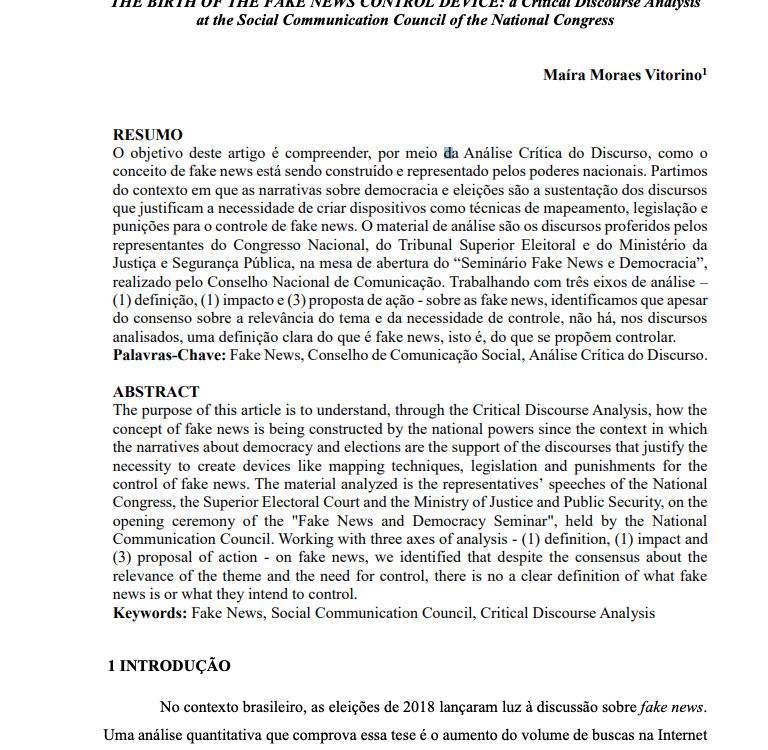
THE BIRTH OF THE FAKE NEWS CONTROL DEVICE: a Critical Discourse Analysis at the Social Communication Council of the National Congress

The purpose of this article is to understand, through the Critical Discourse Analysis, how the concept of fake news is being constructed by the national powers since the context in which the narratives about democracy and elections are the support of the discourses that justify the necessity to create devices […]
1 de December de 2019

Lobbying, corruption, and influence peddling: defining concepts to understand the relevance of regulation

24 de October de 2019

Culture, Power, and Democracy: The Lobby of Creative Industries on Copyright Policies in Brazil

10 de May de 2019

Middle Classes or Average Classes? Globalization and Social Emergencies

9 de May de 2019

Crisis of Representation in Brazilian Society in the 21st Century and Fundamental Rights: The constant attempts to exclude minorities by an increasingly fundamentalist government.

16 de January de 2019

Businesspeople and Politics in Brazil

1 de January de 2019

The right lives on the same side of the city: experts, polemicists, and journalists

1 de January de 2019

Political Reform by the Judiciary: Notes on the Judicialization of Politics in the New Republic

1 de January de 2019

Social Movements as Agents of Meaning Production: Case Studies in Argentina and Colombia

10 de September de 2018

ORGANIZATIONAL STRATEGIES OF THE EDUCATIONAL LOBBY IN THE 87-88 CONSTITUENT ASSEMBLY

The objective of this article is to show how Education interest groups are organized to defend antagonistic interests regarding the constitutional regulation of devices that define the allocation of public resources to private education. We support the existence of a theoretical model, based on the concept of centralization, which describes […]
10 de September de 2018

Comprative analysis of organizational strategies of lobbies in the constituent process os 1987-88

The objective of this article is to show how Education interest groups are organized to defend antagonistic interests regarding the constitutional regulation of devices that define the allocation of public resources to private education. We support the existence of a theoretical model, based on the concept of centralization, which describes […]
26 de February de 2018

Action repertoire of the Deaf Movement in Brazil: campaign for the official recognition of the Brazilian Sign Language

This study intends to analyze the movement of the Deaf community along the process for the Libras Language institutionalization, from 1990 to 2002, from the perspective of the Political Process (TPP), with a special focus on the Repertory of Action with lobbying tactics. The core of the research lies in […]
1 de January de 2018

New Code of Civil Procedure: the judiciary as a pressure group on the legislative process.

In 2015, a new Civil Procedure Code was approved by the National Congress. In the same year, projects aimed at modifying such code were presented, even before it began, in points highly criticized by the national magistracy. The subsequent approval of these changes was accompanied by news reports on the […]
25 de August de 2017

Representatives, Represented, and Social Media: Mapping the Informational Scheduling Mechanism

Being a very recent event in history, studies on internet and politics have flourished in the beginning of the 21st century. Specifically on the absorption and use of this tool by the legislative branch, which is the main focus of this thesis, Cristina Leston-Bandeira (2007) states that we know little […]
7 de March de 2016
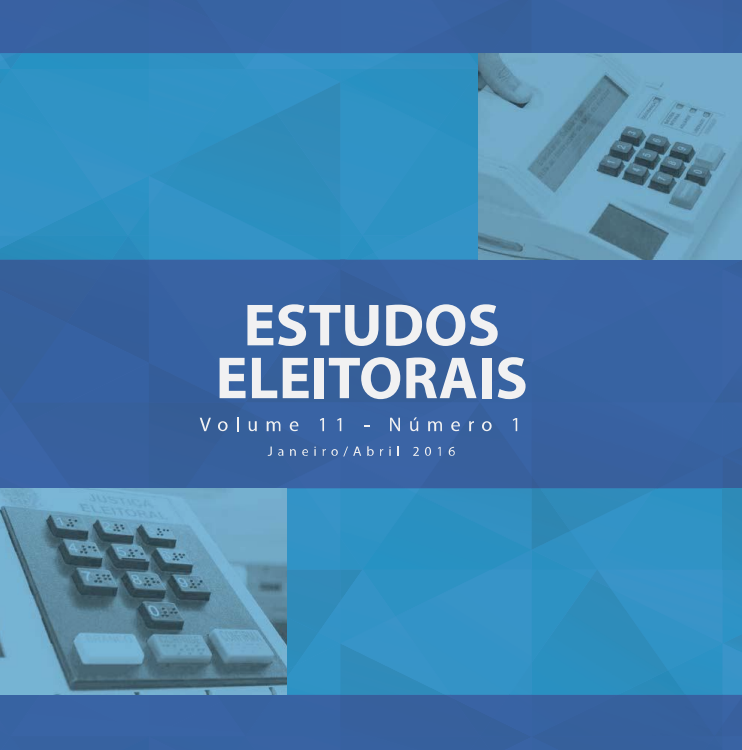
DISADVANTAGES OF THE PRINTED VOTE: MEMORY OF THE DIRECT ACTION FOR UNCONSTITUTIONALITY Nº 4543

The current study means to carry out a critical analysis of the Law nº 13.165/2015 which recreated the printed vote in Brazil, from the perspective of the Federal Supreme Court’s decision rendered in the Direct Action for Unconstitutionality nº 4.345. To accomplish the proposed objective it will be started from […]
29 de April de 2015
“They Were Seven-Headed Beasts” An Island in the Parnaíba Delta (Brazil) in the Spotlight of Transnational Tourism Promotion

This dissertation highlights the promotion of tourism in the Parnaíba River Delta, and more specifically in Ilha Grande de Santa Isabel, Piauí state, Brazil. The research explores the transformations experienced by the island community related to the emergence of old and new tourism practices (federal tourism promotion, real estate/investment and […]
26 de August de 2013
EDUCATION PRESSURE GROUPS AND THE DEMOCRATIC MANAGEMENT LAW

This master’s thesis, as an integral part of the Post-Graduate Program in Education of the University of Brasilia (UnB), follows the Line of Research related to Public Policy and Management in Education. The aim of this paper was to investigate the participation of lobbyists in the legislative process which culminated […]
7 de March de 2013
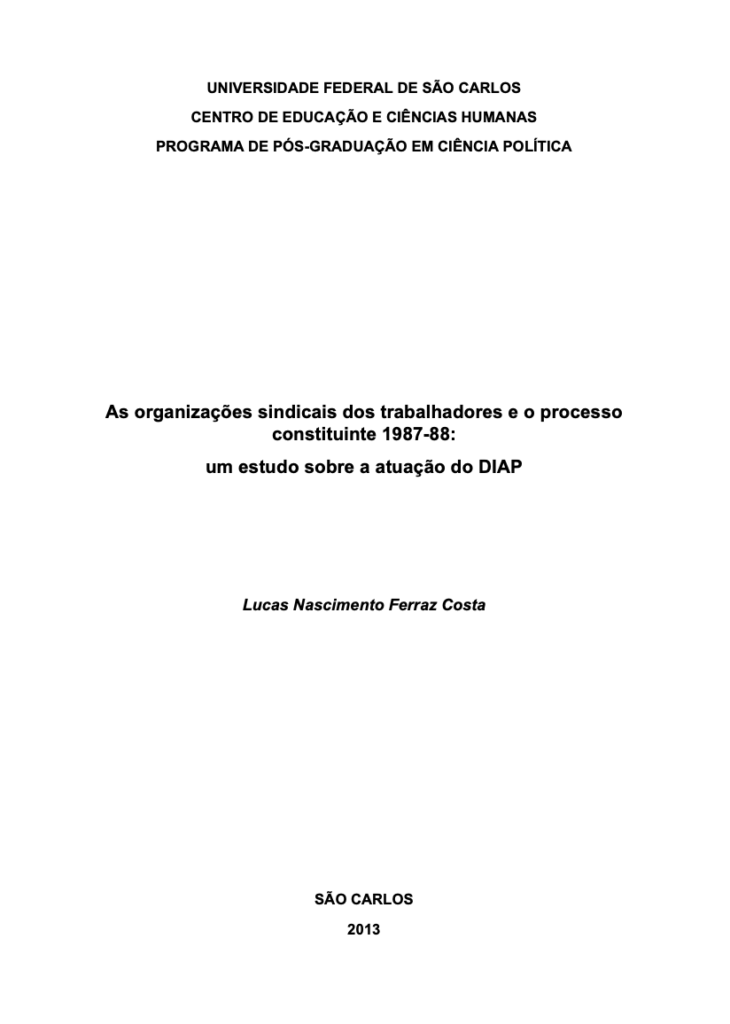
The Workers’ Trade Union Organizations and the Constituent Process of 1987-88: A Study on DIAP’s Role

The goal of this dissertation is to analyze the performance of the Department of Inter Parliamentary Advisory (Departamento Intersindical de Assessoria Parlamentar) (DIAP) in the constituent process of 1987-88. The organization was able to unify the consensual demands of the working class, uniting in a single project for the Constituent […]
29 de January de 2013

Coalition Presidentialism, Provisional Measures, and Constitutional Review in ADI No. 4,029

This research focuses the trial of “ADIN 4.029” by the Supreme Court. The case is characterized by a very atypical of shift of direction by Supreme Court. The case involved examining the constitutionality of Law n. 11.516/07 which created the Brazilian Biodiversity and Conservation Institute. The legislation was contested with […]