


Characteristics of Successful Lobbying Efforts by the National Confederation of Industry
1 de January de 2017
Constitutionalization of Public Policies and Constitutional Amendment in Brazil
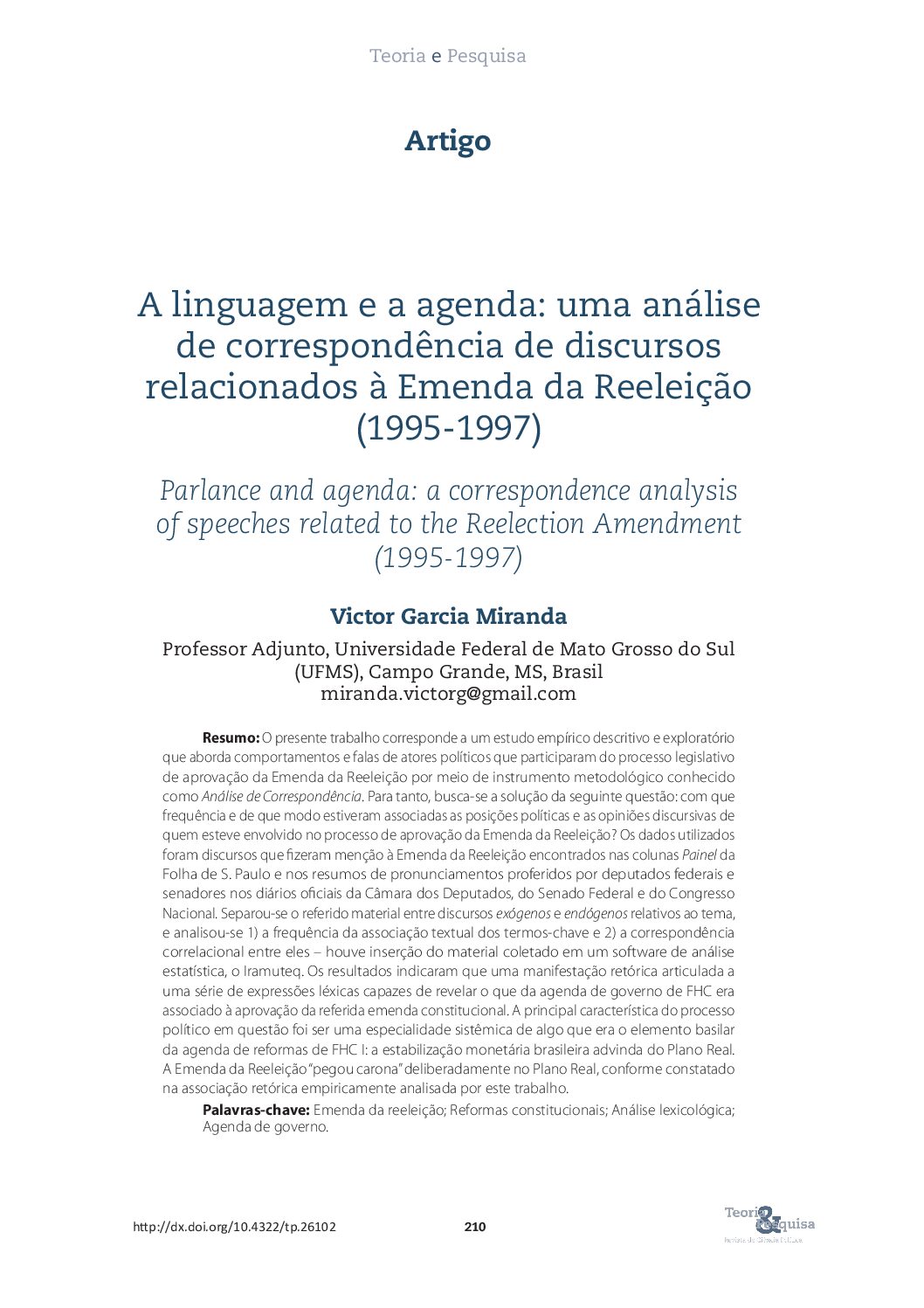
10 de March de 2017Parlance and agenda: a correspondence analysis of speeches related to the Reelection Amendment (1995-1997)
Author:
Victor Garcia Miranda
Abstract:
This work corresponds to a descriptive and exploratory empirical study that addresses the behaviors and speeches of political actors who participated in the legislative process of approving the Reelection Amendment, using a methodological instrument known as Correspondence Analysis. To this end, it seeks to answer the following question: how frequently and in what way were the political positions and discursive opinions of those involved in the approval process of the Reelection Amendment associated? The data used were speeches that mentioned the Reelection Amendment found in the “Painel” columns of Folha de S. Paulo and in summaries of pronouncements made by federal deputies and senators in the official gazettes of the Chamber of Deputies, the Federal Senate, and the National Congress. The material was separated into exogenous and endogenous speeches related to the topic, and the following were analyzed: 1) the frequency of textual association of the keywords and 2) the correlational correspondence between them – the collected material was entered into a statistical analysis software, Iramuteq. The results indicated that a rhetorical statement articulated through a series of lexical expressions was capable of revealing what aspects of FHC’s (Fernando Henrique Cardoso’s) government agenda were associated with the approval of the aforementioned constitutional amendment. The main characteristic of the political process in question was that it was a systemic specialty of something that was the fundamental element of FHC’s reform agenda: the Brazilian monetary stabilization resulting from the Real Plan. The Re-election Amendment deliberately “piggybacked” on the Real Plan, as evidenced by the rhetorical association empirically analyzed in this study.